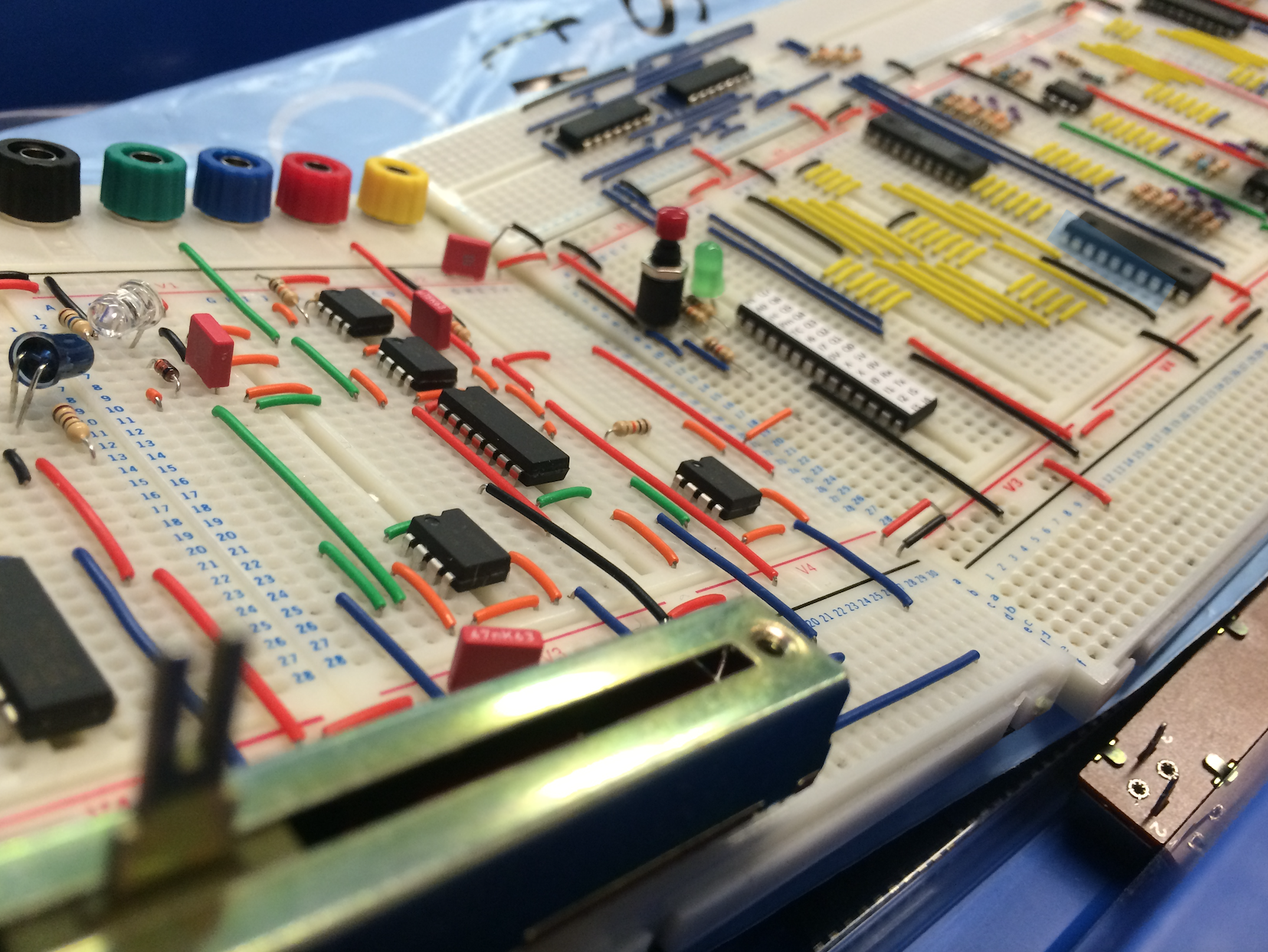


Electronics at DCGS
At DCGS, we are fortunate to be one of the few secondary schools in the country to offer Electronics as a subject. Approximately 50 schools teach it in the UK, totalling around 1000 students at GCSE and 700 at A level. Being such a rare course, it doesn’t have the same platform as other GCSE or A level subjects - especially if you’re new to the school or otherwise unfamiliar with it.
The unique selling point of the course is hands-on experience. Compared to the handful of required practicals in other sciences, Electronics practicals occur every few lessons and you complete an independent project as part of the course. The ability to study theory, build a circuit, and then thoroughly test it not only provides you with a strong basis of understanding but also gives you the satisfaction of learning hands-on skills; furthermore, practical work is a great character-building experience through developing creative project ideas, persevering with problems and helping other students, which aligns closely with our school values.
Beyond schooling, electronics is an evolving global industry forming the backbone of modern life. Current developments in AI, electric vehicles, green energy production and more make it clear that this industry is only going to grow as time goes on. Having electronics-related skills will be incredibly useful whether you’re looking for a career, a hobby, or want to prepare yourself for the future.
Former DCGS students occupy a variety of jobs in the field of electronics and electrical engineering: Max O’Brien, for instance, at Red Bull Racing, and James Arnold at CERN. These alumni both fondly remember Electronics classes: Max said, "It was really the first time I felt I had the freedom to create, investigate, fail, investigate again and fix issues the way I thought best". Both felt the skills they learnt left them in good stead for their future - whether that be lab work skills, an understanding of engineering practice or the patience to troubleshoot a circuit.
Finally, electronics is a lot of fun. Making mistakes is a common occurrence, and the resulting chip going up in smoke or unexpected side effects can be quite the spectacle! Max recounted some classmates seemingly creating ‘free energy’ as their circuit kept running after the power was turned off, "It felt like we'd manage to break the laws of Physics from within the classroom. I've since learnt some of the reasons why it might have functioned the way it did - much to my own disappointment!".
At the forefront of particle physics, James deals with the challenges of operating circuitry with the radiation and electromagnetic interference present in the CERN collider, which can cause circuits to behave unpredictably. This can be dealt with via several methods, such as ‘triplication’ - using three identical circuits so there are backups if one fails. Another method is - and I’m being completely serious here - wrapping components in tinfoil!
Writing: Lakindu (Year 12) and Ben (Year 13)
Editing: Luke (Year 12)
Images: Mr Robertson